

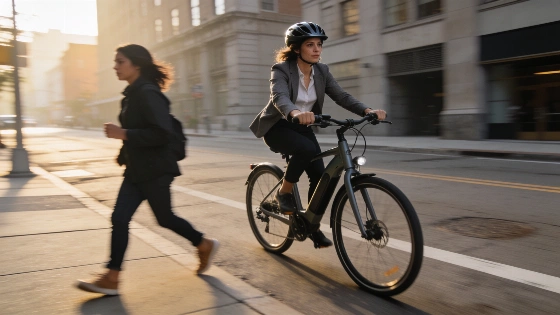
Switching from walking to cycling can make your daily commute up to four times more energy-efficient, but steep hills and muscle fatigue can change the equation fast
Picture your morning: five miles to work, shoes laced, ready to walk. That’s nearly an hour on foot. Hop on a bike, and you’re there in 15 minutes, barely winded. The difference isn’t just about speed. According to research in biomechanics, cycling can be at least four times more energy-efficient than walking—sometimes even more compared to running. But the story isn’t as simple as swapping sneakers for pedals.
Energy efficiency, in this context, means how far your body can move for the same amount of energy burned. For an average adult, walking at a moderate pace uses about 6.1 kilowatt-hours per 62 miles. Cycling at a steady 10 mph? Roughly 3.2 kilowatt-hours for the same distance. That means you travel farther on the same “fuel.” Yet, because cycling covers more ground in less time, you might actually burn more calories per half hour—around 240 to 290, compared to 150 to 190 for walking. The difference is intensity and distance, not just the clock.
Why does cycling feel so much easier? Three biomechanical advantages stand out. First, your legs don’t have to lift your full body weight with every step. The bike seat supports you, and your legs move in a smooth circle, not a jarring stride. Second, cycling eliminates the constant impact and braking that comes with each footfall. The wheels roll, the chain transmits power, and almost all your effort goes into moving forward. Third, gears let you adjust your cadence, so your muscles don’t have to contract at awkward speeds. You can keep a comfortable rhythm, even as you speed up or slow down.
On a flat city route, these factors add up. Most people can ride five miles at 10–12 mph without breaking a sweat, arriving in a fraction of the time it takes to walk. The sensation of gliding isn’t just in your head—it’s a real reduction in wasted energy. But the equation changes when the terrain shifts. On steep hills, especially those with a grade over 15 percent, walking can actually become more efficient than cycling. Your legs may struggle to generate enough force in a circular motion to push both you and the bike uphill, while walking lets you use your body’s natural mechanics to climb. Downhill, the reverse is true: walking becomes harder on the joints, while a bike coasts with almost no effort.
For those who want to maximize daily movement without feeling drained, the choice between walking and cycling isn’t always obvious. Some find that switching up their routine—like alternating between walking and cycling—can help avoid fatigue and keep motivation high. In fact, as one health journalist discovered after a month of using a walking pad, the biggest gains sometimes come from simply changing how you move, not just how much. (Read about her experience here.)
According to Psytheater.com, the real question isn’t which activity burns more calories or gets you to work faster. It’s about matching your movement to your body’s needs, your environment, and your goals. For some, the low-impact, joint-friendly nature of cycling is a game-changer. For others, the simplicity and accessibility of walking win out—especially where hills, weather, or safety are concerns.
Recent data from the U.S. Department of Transportation shows that cycling rates have risen by nearly 20% in major cities since 2020, driven by a mix of health, environmental, and economic factors. Meanwhile, walking remains the most common form of physical activity for American adults, with over 60% reporting regular walks of at least 10 minutes. Both activities are linked to lower rates of chronic disease, improved mood, and better cardiovascular health, but the best choice often depends on personal preference, local infrastructure, and physical limitations.
Biomechanics, the study of how our bodies move, plays a growing role in designing safer, more efficient ways to stay active. Researchers are now exploring how small changes in posture, cadence, and equipment can reduce injury risk and boost energy efficiency for both walkers and cyclists. As cities invest in better bike lanes and pedestrian paths, understanding these mechanics can help more people find the right balance between effort, enjoyment, and long-term health.