
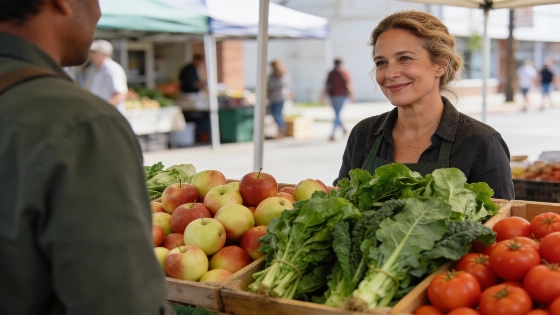
A longtime produce vendor in a busy market refuses to let money dominate her thoughts or define her value. Her story challenges the relentless financial anxiety many Americans face every day.
She wakes up before sunrise. The market is already stirring. Most people around her are thinking about bills and debts. She is not. For over thirty years, she has stood at the same corner, selling apples, greens, and tomatoes. She does not let money run her life. This is a choice, not denial. She draws a line in her mind. Money does not get to decide her worth.
Her stand is easy to spot. It overflows with local produce. Regulars greet her by name. She once started law school. That path did not last. The pull of the earth was stronger. She traded legal codes for soil and seasons. Südwest Presse summed up her view: "Money is not important." That line is blunt. It goes against the grain. Most Americans feel financial stress every day. She refuses to let it in.
Regional markets in Tübingen feature around 100 suppliers, highlighting the city’s strong tradition of local food commerce.
What does this look like in real life? She plans her days by the weather and the fruit, not by profit. Her regulars know she will be there, rain or shine. She offers produce with a calm patience. It stands out. She is not the richest vendor. She is the most steady. She does not worry about the bottom line.
Leaving law school was not a whim. She found more meaning in talking with customers and watching things grow. Legal arguments felt distant. The numbers in her ledger go up and down. Handing someone a fresh apple never changes. She earns enough to live. That is enough for her. Health and sleep matter more than extra profit.
She does not ignore reality. Bills still come. She just refuses to let money take over her mind. She draws a boundary. Success, for her, is a customer who returns, a name remembered, a real smile. Not a quarterly report. When self-worth is not tied to a bank balance, the mental load can feel lighter. The numbers may not change. The feeling does.
The regional autumn market in Tübingen, scheduled for October 10, 2026, is promoted under the motto 'Regional ist genial!' and focuses on products from the Neckar-Alb region and traditional orchard meadows. While this demonstrates the city’s commitment to local food systems, no independent reports confirm the participation or current status of Gerlinde Beck as a vendor.
She is not the only one. Other workers in hands-on trades have also chosen meaning and stability over constant financial worry. The difference is not in their paychecks. It is in how much space money takes up in their minds.
Her life is full of small joys. Most cost nothing. She likes old cars. She watches pigeons near her stand. She listens to market chatter. Sometimes she jokes about aliens. She steers talk away from cash. Her wealth is in stories and connections. Not in bills or coins. There is another Gerlinde Beck—a sculptor, according to online biographies. This one is happy to be known as the vegetable seller who picked a different way to measure success.
She has advice for anyone curious about her approach. Ask yourself: When do you think most about money? What brings comfort or joy that costs little or nothing? She does not shame anyone facing real hardship. She just wants people to notice when money starts to crowd out life.
Her story is not a rulebook. It is a sharp reminder. The mental weight of money is not just about income. It is about boundaries and values. It takes courage to define success for yourself. In a culture obsessed with financial status, her quiet resistance is radical. It is also sane. The lesson is not to ignore money. It is to refuse it the power to shape your identity or steal your peace. That is a kind of wealth most budgets never count.
Financial stress is one of the top triggers for anxiety and burnout in American adults. Research shows that chronic worry about money can cause sleep problems, strain relationships, and even harm physical health. Cognitive behavioral therapy (CBT) and acceptance-based methods can help people spot unhelpful thought patterns about money and build better coping skills. For some, setting clear boundaries about when and how to think about finances can lighten the mental load. It can free up energy for things that matter more.