
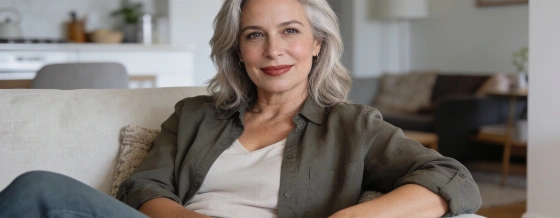
Choosing to stop coloring gray hair is more than a style decision. Experts say it often signals a rare psychological profile—one that resists social pressure and values authenticity over image
For decades, gray hair—especially on women—was seen as a sign of neglect or aging best hidden from view. But in recent years, more Americans are letting their natural silver strands show, even after years of regular dye jobs. Psychologists say this choice is rarely just about appearance. It often points to a deeper pattern: a strong sense of authenticity and a willingness to push back against social expectations.
In a culture that still prizes youth and equates gray hair with decline, the decision to go natural is not neutral. Many people continue to color their hair to avoid being labeled as “old” or less capable, particularly in the workplace. Those who stop covering their grays are often making a conscious tradeoff—accepting the risk of social judgment in order to feel more aligned with their true selves. According to Psychologies, this is not about superiority, but about prioritizing internal values over external approval.
Research backs up this pattern. A 2021 study published in PubMed found that older women frequently use hair dye to avoid stigma and the negative assumptions that come with visible aging. The study identified a clear internal conflict: the desire to appear competent versus the need to feel authentic. Many participants worried that gray hair would undermine their credibility, yet ultimately chose authenticity, even at a social cost. This echoes the classic theory of stigma by Erving Goffman, where people try to hide traits that might trigger rejection or contempt.
Authenticity and Social Pressure
Letting gray hair show is not just a personal style statement—it’s a visible act of resistance against ageism and the relentless push for eternal youth. In most Western societies, gray hair signals age, and age is still stigmatized, especially for women. The willingness to be seen as older, and to accept the judgments that come with it, often reflects a rare psychological profile: people who value coherence between how they feel, how they look, and how they live.
Studies suggest that these individuals tend to prioritize their own feelings over the opinions of others. They show greater tolerance for social remarks or criticism and are more likely to redefine aging as a meaningful phase of life, not just a period of decline. This pattern is not rigid—there’s no single “gray hair personality”—but the trend is clear: authenticity and resilience to social pressure go hand in hand.
It’s important to note that coloring your hair does not mean you lack authenticity. Many people enjoy dyeing their hair for aesthetic reasons or comfort, and that can be just as true to self. The real question, experts say, is whether your choice reflects your own values or is mainly a response to fear of judgment. This tension between self-image and social expectation is not unique to hair. For example, the urge to apologize for a messy home before guests arrive, as explored in this analysis of home-related anxiety, often reveals deeper patterns rooted in self-worth and social pressure.
Well-Being and Life Satisfaction
Research from 2022 involving over 300 participants found a strong link between authenticity and psychological well-being. People who described themselves as highly authentic also reported greater life satisfaction, and those around them tended to agree. Authenticity, the study noted, is not just a private feeling—it’s visible to others and shapes how we are perceived in relationships and at work.
Another study from 2015, which surveyed 400 adults, found that authenticity in romantic relationships predicted more stable and warmer connections. People who are willing to show their true selves—gray hair and all—often enjoy stronger social bonds that are less dependent on performance or appearance. This suggests that the benefits of authenticity extend beyond personal satisfaction to the quality of our closest relationships.
According to Psychologies, the choice to embrace gray hair is rarely about hair alone. It’s a visible marker of a deeper orientation toward life—one that values honesty, coherence, and resilience in the face of social pressure. The decision may not guarantee happiness or mental strength, but it often signals a willingness to live in alignment with one’s own values, regardless of what others expect.
According to the U.S. Census Bureau, nearly 20% of Americans over age 55 now report letting their natural gray hair show, a figure that has doubled since 2010. Market research from 2023 shows a steady decline in hair dye sales among women ages 40–65, while online communities focused on “gray pride” have grown by more than 300% in the past five years. These numbers reflect a broader cultural shift toward acceptance of aging and a redefinition of what it means to look competent, attractive, and authentic at any age.
Authenticity is a core concept in modern psychology, often linked to self-acceptance, resilience, and well-being. It refers to the ability to act in ways that are consistent with one’s values, beliefs, and feelings, even when those choices go against social norms. Therapists sometimes use authenticity as a goal in treatment, helping clients identify where they are conforming out of fear rather than genuine preference. In daily life, authenticity can be seen in small acts—like letting gray hair show or refusing to apologize for a lived-in home—that signal a deeper alignment between inner experience and outward behavior.