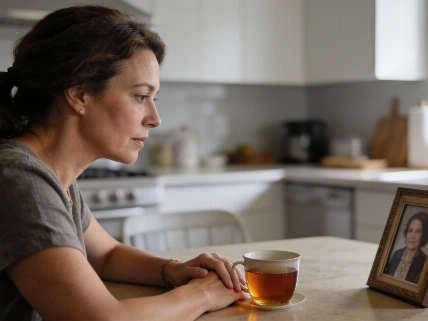


Nine days after her mother’s death, Julia is replaying angry words spoken during a frightening stretch of illness. A therapist says those final days cannot define their entire bond.
For nine years, Julia’s mother had lived with heart disease. After a stroke, she got back on her feet, but other health problems followed what Julia saw as errors by doctors. Five years ago, while Julia was pregnant with a long-awaited child, her mother agreed to heart valve surgery. She later helped care for her granddaughter, now four.
Julia is 38, and her mother died in a hospital nine days ago. Julia keeps returning to what she said before her mother’s death: that she was hurting herself and the family by resisting care, and that she should stop making them suffer. Julia had wanted her mother to live. Now she is asking how to go on with the clash between that love and those words.
The past year had been harder. Julia was working and felt increasingly on edge. At home, that strain often spilled onto other people. Affection toward her mother had grown scarce, and Julia says she sometimes spoke in anger. Her mother was tired of hospitals and resisted more care.
Five days after a hospital discharge, her mother got worse again. The sleepless nights returned, along with Julia’s fear of watching her decline.
Those details do not make the words harmless. They do put them in context: fear and exhaustion can collide when a loved one is gravely ill. They do not prove Julia did not love her mother, or make the final days go well. Grief can make one painful scene feel like the whole story.
The American Psychological Association describes survivor guilt as regret that one did not do enough to prevent another person’s death or save them. After a loss, people may replay final conversations and decisions. Conflicts can return to mind, too. The feeling can arise even when a family member had no objective reason to believe they were responsible. The APA definition describes a subjective sense of responsibility, not proof that a relative’s words caused a death.
Tatyana Sorokina, a therapist trained in logotherapy and existential analysis, urges Julia to look beyond that final stretch. Her mother knew her through childhood and adolescence, including earlier times when Julia may have been sharp or difficult. The question is not whether Julia can find an excuse for every harsh word. It is whether she can see that her mother’s life with her daughter held far more than those moments.
Julia fears her mother felt like a burden. Her mother may have known that illness placed demands on the family, Sorokina says. But a parent nearing death may also focus on what she can still give her children. Julia’s mother had helped with her granddaughter and shared years of family life. Her illness and weakness did not erase the strength she had drawn on while facing the end of her life.
The strain of tending to an ill family member also shapes the story in care under strain, though Julia’s loss is her own. This is not a comparison between families or a ranking of pain. It names how care can leave people scared and depleted, sometimes prompting words they wish they could take back.
Research on bereaved family caregivers shows how grief can change over time. A study followed 496 caregivers of patients with cancer for two years after the death. During that period, mental quality of life improved. Physical quality of life remained relatively stable. Symptoms of depression and complicated grief declined. The study tracked caregivers’ adjustment over time, not the circumstances of Julia’s mother’s illness. Its findings are reported in the PubMed-indexed study.
Julia cannot change those last words. Sorokina points her toward the bond she can build with her four-year-old daughter, marked by care rather than a future tally of regrets. Her mother’s help and presence remain part of what Julia carries forward.
Grief has no neat schedule, and guilt may return as Julia recalls the hospital and the final days. She can let those memories remain part of the record without treating them as the only truth about her family. Sorokina’s advice is to keep building her relationship with her daughter. Julia’s mother helped care for the girl, now four.