
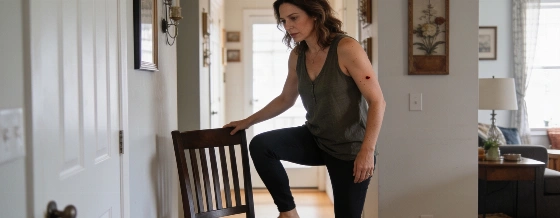
Most American homes make movement too easy, quietly eroding balance, flexibility, and cognitive sharpness. Subtle changes to your living space can help protect both your body and mind as you age.
Most people blame a lack of gym time or a desk job for declining mobility and mental sharpness. But the real problem might be closer than you think: your own living room. American homes are built for comfort and convenience, but that ease can quietly chip away at your balance, flexibility, and mental agility. When daily life requires almost no effort, your body and brain miss out on the small challenges that keep joints moving, balance steady, and thinking sharp. Over time, this can lead to a gradual, almost unnoticed loss of both physical and cognitive resilience.
Researchers call this the "enriched environment" effect. In early animal studies, rodents raised in cages with obstacles and toys developed denser brain connections and learned faster than those in bare cages. Human studies are less clear, but early evidence suggests that homes with small, varied challenges can help maintain neuroplasticity—the brain’s ability to adapt and rewire. According to Psytheater.com, the goal isn’t to turn your house into a gym, but to add subtle motor and mental tests to your daily routine. The Cleveland Clinic recommends using visual cues, reducing distractions, and keeping pathways clear to support attention, memory, and safe movement. (Cleveland Clinic)
A randomized intervention in August 2026 found that using a HEPA air purifier at home for just one month led to a small but statistically significant improvement in brain function among adults aged 40 and older.
Think about how you move through your home. Do you ever have to step over anything, balance on something narrow, or reach and stretch in new ways? Most people don’t. Physical therapist Mark Evans, who works with older adults, suggests simple changes: put a sturdy chair in a hallway and step over it each time you pass, starting with support and working up to hands-free. String a cord at knee height to encourage ducking or stepping over. Lay down a narrow board to practice balance. Even sitting on the floor instead of the couch for part of the day can help your hips and knees move through a fuller range of motion, counteracting the stiffness that comes from always sitting at ninety degrees.
These small challenges aren’t about burning calories or building muscle. They keep your nervous system alert and adaptable. Repeated, low-stakes movement puzzles help maintain executive functions like planning, attention, and self-control. The aim isn’t to boost your IQ, but to keep your body and mind working together as you age. As recent research on social connection and brain health shows, the spaces we live in shape not just our habits, but our brains. Studies summarized by Alzinfo and published in The Lancet Public Health found that regular leisure-time physical activity—like brisk walking—has the strongest link to lower cognitive risk. The fastest walkers had about half the risk of cognitive impairment in old age compared to slower walkers. (Alzinfo)
Safety comes first. Experts at the Cleveland Clinic and Mayo Clinic caution against making your home more complicated or risky, especially if you have a history of falls, dizziness, or cognitive issues. Start with the simplest version of any new movement, and only progress when you feel steady. Remove obstacles at night or in low light, and make sure any added equipment—like a pull-up bar or balance beam—is secure before use. If you feel pain or instability, talk to a healthcare provider before making more changes.
While the concept of an enriched environment is rooted in classic neuroscience, the most reliable recent data for adults now emphasize improving air quality, structured physical activity, and reducing clutter or fall risks over adding obstacles at home. Practical recommendations focus on increasing movement variety and minimizing predictable passivity, rather than making the home artificially challenging.
Cleveland Clinic
What stands out is how little it takes to make a difference. You don’t need fancy equipment or a full home makeover. A few intentional tweaks can turn your home from a passive comfort zone into a space that keeps your body and mind engaged. The goal isn’t to chase some perfect environment, but to make daily movements just challenging enough to keep you alert. In a culture that prizes convenience, sometimes the best thing you can do is make life a little less easy—on purpose.
Neuroplasticity—the brain’s ability to form and reorganize connections—isn’t just a buzzword. It’s the foundation of lifelong learning and adaptation. While structured exercise and brain training have their place, the spaces we move through every day may have an even bigger impact on long-term health. With a few small, thoughtful changes at home, you can support not just your mobility, but the very structure of your mind.