
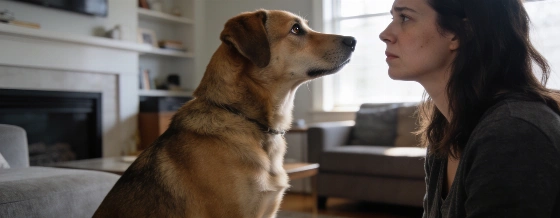
Dogs don’t just sense your mood—they process human facial expressions in ways that reveal a surprising level of emotional awareness, new brain imaging research shows
Most dog owners have noticed it: the moment your mood shifts, your dog seems to pick up on it. But recent research from a team at the University of Vienna suggests this sensitivity goes far beyond simple intuition. Using functional MRI scans on awake, unrestrained dogs, scientists found that dogs can distinguish between a range of human facial expressions—including happiness, sadness, fear, and anger—by processing them in distinct regions of their brains.
Earlier studies mostly focused on whether dogs could tell a happy face from a negative one. This new work, however, digs deeper. The researchers trained 14 dogs to remain still and alert during ten-minute MRI sessions. In the first phase, eight dogs viewed images of unfamiliar human faces showing either happiness or a neutral expression. Smiling faces triggered increased activity in brain areas linked to cognition and reward, suggesting dogs not only notice positive emotions but may also experience a kind of social reward from them.
In a second experiment, 12 dogs were shown faces expressing happiness, sadness, fear, or anger. The dogs’ brains responded differently to each negative emotion, especially distinguishing fear from anger and sadness. However, the scans showed that dogs struggled to tell the difference between angry and sad faces. The researchers believe this may be because a single facial expression doesn’t always provide enough context for a dog to fully interpret what a person is feeling.
Beyond the Face
In daily life, dogs have access to far more than just our facial cues. They observe our posture, movements, tone of voice, and even subtle changes in scent. The study also found that dogs scan multiple areas of the human face—eyes, mid-face, and mouth—when processing expressions. When confronted with a positive face, dogs focus especially on the eyes, which may help them pick up on subtle emotional signals.
These findings add to a growing body of evidence that dogs have evolved to read human emotions with remarkable accuracy. As Psytheater.com reports, understanding how animals interpret our emotional states can also shed light on the ways humans connect with each other, especially in moments of stress or vulnerability. The ability of dogs to tune into our feelings may be one reason they are so effective as emotional support animals and companions for people facing mental health challenges.
Limits and Implications
Despite their sensitivity, dogs are not perfect emotion detectors. The study’s lead author notes that dogs’ difficulty distinguishing between sadness and anger may reflect the limits of facial cues alone. In real-world settings, dogs rely on a combination of signals—body language, voice, and context—to interpret what we’re feeling. This complexity is part of what makes the human-dog bond so unique and adaptable.
According to iScience, the research underscores the importance of recognizing dogs as emotionally attuned beings. Acknowledging their capacity to understand us can change how we communicate with them and how we care for their emotional needs. The study, published in August 2026, highlights the ongoing evolution of the human-animal relationship and the sophisticated ways our pets engage with our inner lives.
In the United States, more than 65 million households include at least one dog, according to the American Veterinary Medical Association. The use of therapy and service dogs has grown steadily, with thousands of animals now trained to assist people with anxiety, PTSD, and other mental health conditions. As research continues, scientists hope to better understand how dogs’ emotional intelligence can be harnessed to support human well-being in clinical and everyday settings.
Emotional intelligence in animals is a rapidly expanding field. Researchers are now exploring how dogs’ ability to read human emotions compares to that of other domesticated species, and what this means for therapy, training, and animal welfare. The more we learn about the emotional lives of our pets, the more we can foster relationships built on mutual understanding and trust.