
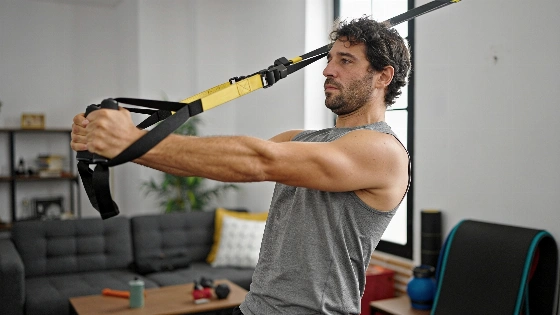
Sergio Ramos uses resistance bands in his home workouts. Research found they can produce strength gains comparable to weight training when users work near fatigue and gradually increase resistance.
As a resistance band stretches, it gets harder to pull, changing the load through each repetition. Sergio Ramos has added the simple tool to his home training alongside the advanced machines he uses. For people exercising at home, that adjustable tension offers a way to work several muscle groups without a weight rack.
A pair takes up little room and can target the chest and back. Other exercises work the shoulders or lower body, including the glutes. Bands cost little, but results depend on choosing the right resistance and keeping each movement under control.
What the evidence says
A systematic review published in SAGE Open Medicine concluded that resistance-band training can produce strength gains comparable to conventional weight training. In 2019, a meta-analysis by J. S. Lopes and colleagues compared elastic resistance with conventional weights across eight controlled studies lasting about 8 to 12 weeks. It covered upper- and lower-body programs and found no statistically significant difference in strength gains between the methods, as summarized in this review of the comparison.
That finding came with conditions: users need to work close to muscular fatigue and increase resistance over time. It does not mean every band routine will match every weight program. Nor does it mean the equipment prevents injuries.
The load is lighter near the start of some movements and rises as the band stretches. How much resistance a person feels also depends on the stretch and body position. The anchor point matters too, so a “light” or “heavy” label alone tells only part of the story. GrindLab describes the changing tension as progressive resistance. It can make a movement feel smoother than lifting a fixed heavy load, but technique and the band’s condition still matter.
Men’s Health España has described bands as a way to ease back into exercise after a break. Its article says they may help limit lingering soreness and lower injury risk when used gradually. Those are possible benefits, not guarantees. A previous look at training intensity and recovery also centers on adjusting effort instead of pushing hard by default.
Fitness specialist Daniel Rodas summed up their appeal with the exact phrase, “les bandes élastiques sont une investissement minimal avec un retour maximal de bénéfices”. Ramos is among the high-level athletes who use bands in training aimed at speed and stability. Their use alone does not show how much they contribute to an athlete’s performance.
Use them with care
After time off or an injury, starting with a light or medium band can make a movement easier to control. Increase the range gradually. Move to a stronger band only when the current one feels manageable. Men’s Health España cautions against trying to “détruire” the muscle during a return to exercise. Doing too much too soon can prolong recovery.
Santé publique Ottawa recommends checking bands for cracks or faded patches before use. Inspect the band before loading it, follow the manufacturer’s instructions and secure it to a stable anchor. Keep it from snapping toward the face, and control both the pull and the return. Physiotherapists also use bands in rehabilitation to strengthen vulnerable areas without overloading them. Anyone returning from an injury should follow guidance from a health professional.
A short home routine
Choose a band that allows about 10 repetitions with steady form while making the last few challenging. Nike’s training site suggests 2 to 3 sets of 10 to 15 repetitions per exercise, with a short rest between sets. The American College of Sports Medicine recognizes resistance bands and body-weight exercises as strength-training options. Its guidance calls for working all major muscle groups at least twice a week. Around 10 weekly sets per muscle group is cited as a hypertrophy target, not a required starting minimum, in this summary of ACSM guidance.
For squats, stand on the band and position it across the shoulders to work the thighs and glutes. For rows, place the band under the feet and pull toward the navel to work the back.
A chest press uses the band behind the back, with the hands pushing forward. Lateral raises work the shoulders while the person stands on the band.
Side steps with a mini-band around the knees target the glutes.
Track the band’s color or resistance from session to session. When the final repetitions no longer feel demanding, add a little tension or stretch the band farther, as long as the movement stays controlled. Progress can also come from adding repetitions or sets. Another option is to adjust training frequency or make an exercise more challenging. Stop the set when form starts to break down. That is the practical limit the source describes as “échec propre”.