
If crunches hurt your back or you hate floor workouts, experts say these six standing ab moves can build core strength, improve posture, and reduce daily strain
Most Americans spend their days upright, not lying on a mat. That’s why a new wave of standing ab routines is gaining traction among physical therapists and exercise physiologists. Instead of crunches or planks, these moves target the core while you’re on your feet—making them more relevant to real life and easier on the lower back. According to the Cleveland Clinic, standing ab exercises can help stabilize your spine, support better posture, and reduce the risk of back pain, especially for those who dislike floor work or are recovering from pregnancy.
What sets these exercises apart is their focus on control, not speed. The goal isn’t to burn out your abs, but to build deep, functional strength that translates to everyday movement—like lifting groceries, twisting to reach a shelf, or steadying yourself on stairs. Experts emphasize the importance of proper form: keep your pelvis neutral, breathe steadily, and avoid pushing through pain. If you feel sharp discomfort or dizziness, scale back or skip the move. For those with balance issues, a sturdy chair can provide support.
Before jumping into dynamic moves, specialists recommend activating your transverse abdominis and pelvic floor while standing. Stand with feet hip-width apart, exhale as if blowing through a straw, gently draw your belly button toward your spine, and contract your pelvic floor. Hold for 5–10 seconds, repeat for three sets, and work up to 20 seconds as you gain strength. This foundational drill is especially useful postpartum or for anyone with diastasis recti.
Functional Core Training
The Cleveland Clinic’s routine features six standing ab exercises, each designed to engage multiple muscle groups and mimic real-world actions. Aim for 10–15 reps per side or 30 seconds per move, two to three times a week. Here’s how to do them safely:
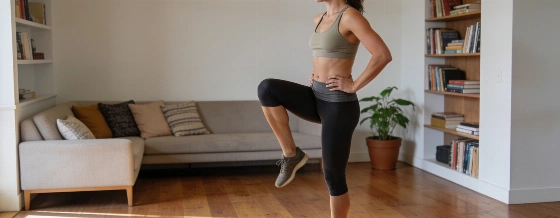
1. March (Knee Lifts): March in place, lifting one knee at a time toward your chest while keeping your torso upright. For more challenge, add a gentle twist toward the raised knee. Don’t lean forward—keep your spine neutral.
2. Overhead Side Bend: With arms extended overhead and feet hip-width apart, slowly bend your torso to one side without shifting your hips. This targets the obliques and lower back stabilizers. Avoid dropping your head or looking down.
3. Standing Hip Abduction: Stand on one leg, lift the other out to the side with a flexed foot, and keep your core and hips steady. Use a chair for balance if needed. This move strengthens the core, glutes, and hips together.
4. Standing Twists: With feet planted and knees slightly bent, hold your arms at chest height and rotate your torso right and left. Keep your hips facing forward and move slowly to avoid straining your spine.
5. Crossover Toe Touch: Step your right foot forward and reach your left hand toward or near your right toes, then switch sides. This combines core engagement, oblique work, and hamstring stretch. To prevent dizziness, focus your gaze on a spot on the floor and limit your range if needed.
6. Wood Chop: Using a light dumbbell or water bottle, start with arms overhead to one side and sweep diagonally down toward the opposite hip, mimicking a chopping motion. Keep your abs braced and avoid twisting your knees. Ten reps per side is enough for most people.
Safety and Progression
Standing ab routines are accessible for most adults, but attention to detail matters. Move slowly, especially during rotations, and stop if you feel pain or instability. If you’re new to exercise or have a history of back issues, consult a physical therapist before starting. For those traveling or working long hours, these moves can be done in a living room or even a hotel room—no mat required. If you’re dealing with a difficult travel companion or stressful environment, as discussed in this guide to managing chronic complainers on vacation, a quick standing ab session can help reset your mood and posture.
Research published in the Journal of Strength and Conditioning Research found that standing core exercises activate more stabilizing muscles than traditional crunches, especially in the obliques and lower back. In a 2022 survey, over 60% of physical therapists recommended standing ab routines for clients with chronic back pain or limited mobility. These exercises are also gaining popularity in workplace wellness programs, where short, equipment-free routines fit into busy schedules and help reduce sedentary strain.
Core strength is more than a fitness trend—it’s a foundation for daily function, injury prevention, and long-term health. The core includes not just the abs, but also the muscles along the spine, hips, and pelvic floor. Building this network through standing exercises can improve balance, reduce falls, and support healthy movement patterns as you age. For those seeking a practical, back-friendly way to train, standing ab routines offer a science-backed alternative to traditional floor workouts.