

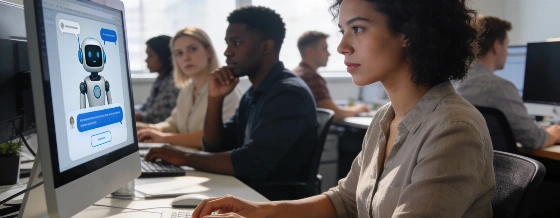
A leading AI educator warns that employees who cannot use artificial intelligence tools in daily office work may be pushed out of the job market within two years.
If you can't use artificial intelligence tools as easily as email or Excel within the next two years, your job could be at risk. That's the warning from Jon Hernández, a Spanish AI educator, who says time is running out for anyone whose work happens behind a screen. He isn't talking about coding or building algorithms—he means being able to work with AI as naturally as you would with a coworker.
For office workers, the expectations are changing quickly. AI is no longer just a bonus skill or a line on a resume. It's becoming the new standard, a basic requirement that separates those who adapt from those who fall behind. Hernández predicts that in Spain—and likely even sooner elsewhere—anyone who isn't "fluent" in AI by 2026 could struggle to find work in their field.
PwC’s 2026 Global AI Jobs Barometer found that jobs requiring explicit AI skills offer an average advertised wage premium of 62% compared to similar roles without AI requirements.
What does "fluent" mean here? It's not about writing code or understanding machine learning theory. It's about using AI chatbots to draft emails, summarize reports, analyze spreadsheets, or prepare for meetings. It means breaking down a task, choosing the right tool, and refining the results—instead of just accepting whatever the AI gives you.
Some workers might feel safe because their managers are just as unfamiliar with AI. But that won't last. Hernández points out that many companies still rely on manual processes and haven't even mastered Excel, let alone AI. This lag can create a false sense of security. Once leadership understands what AI can do, the pressure to adapt will come quickly.
For people who work away from screens—like those in trades or field jobs—the risk is less immediate. But for anyone in a digital role, expectations are shifting fast. Job postings already list AI assistants as a required skill. Avoiding these tools out of fear or digital fatigue only increases anxiety and the risk of being left behind.
A Bipartisan Policy Center analysis using Lightcast and Census Bureau data reported that postings listing AI skills rose 165% year over year as of August 2026, with sustained acceleration seen since late 2025.
So how do you stay relevant? Hernández suggests a few habits: set a clear goal before using an AI tool, break tasks into smaller steps and automate what you can, always double-check AI-generated numbers and names, adjust your prompts instead of starting over, and never upload sensitive documents to public AI systems. These skills are quickly becoming as basic as knowing how to use a spreadsheet.
Adapting isn't about chasing every new tech trend. It's about building digital flexibility. Workers who use AI to save time, check facts, or organize information will stand out for their adaptability. Those who resist may be seen as out of step, especially as managers start to expect AI fluency as a given.
If the pace of change feels overwhelming, it's worth remembering that digital transitions have always brought discomfort. As reported earlier, even small changes in routine can cause fatigue and stress. The difference now is the speed and scale. The window to get comfortable with AI is closing, and the consequences for ignoring it are more concrete than ever.
Hernández's warning isn't a doomsday prediction. It's a call to action. The next two years will reward those who build practical AI skills and penalize those who wait. In this environment, adaptability is more than a buzzword—it's the new currency of employability, and the cost of inaction is high.
Artificial intelligence at work isn't about replacing human judgment but about amplifying it. The most effective employees will use AI to handle routine tasks, freeing up time for creative problem-solving and deeper analysis. As AI tools become part of daily workflows, the ability to work with these systems will shape who succeeds in the modern office.
The 2026 Global AI Jobs Barometer found that postings requiring explicit AI skills grew 69% across 27 countries and territories, compared to just 9% growth in the wider jobs market. This shows how quickly employer expectations are changing.
Recent labor market reports also show that demand for AI skills is spreading beyond traditional tech roles into planning, content creation, marketing, and other office jobs. AI fluency is becoming a basic requirement for a growing range of professions.
In the UK, Indeed's July 2026 data showed that AI-related job postings made up over half of all openings in data and analytics and software development, and nearly a third in IT systems and marketing. This points to how widely AI is being adopted across industries.
The World Economic Forum notes that as AI changes the workplace, employers are looking for not just technical skills but also emotional intelligence, grit, and resilience. These human qualities complement AI and are essential for navigating the new world of work.