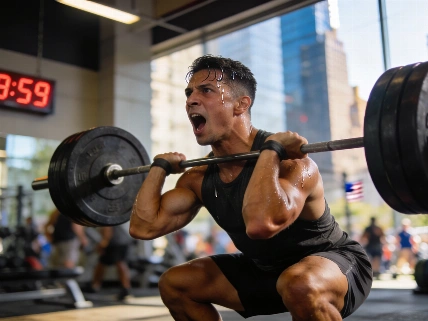

If your arms won't grow no matter how many curls or presses you do, new research explains what's missing from your routine and what really drives muscle gain.
If you want bigger arms, chances are you’re focusing on the wrong exercises. A recent meta-analysis of 32 studies, led by Milo Wolf, points out a common mistake: most gym routines miss the main factors behind arm growth. Relying only on biceps curls or assuming presses and pull-ups will cover everything leaves key muscles undertrained—and your arms looking the same as ever.
Here’s what most people overlook: the triceps make up more than twice as much arm mass as the biceps, and deeper muscles like the brachialis and brachioradialis account for nearly half the size of your elbow flexors. If you’re doing endless curls but skipping focused triceps work, you’re missing most of your growth potential. The long head of the triceps, especially, needs to be trained in a stretched position—think overhead extensions, not just pushdowns or bench presses.
Research consistently shows that weekly training volume—specifically, the number of challenging sets per muscle group—is a stronger predictor of muscle growth than any single exercise choice.
— RepCount App
Wolf’s review gets specific. For biceps, the best results come from exercises that load the muscle when it’s fully stretched, like incline curls or cable curls with your arm behind your torso. Add hammer curls to target the brachialis and brachioradialis, and include a supinated or concentration curl for extra detail. For triceps, overhead extensions (with dumbbells or cables) are essential, followed by lying extensions like skull crushers or JM presses. Close-grip bench presses can help, but they aren’t enough on their own.
Volume matters, but not the way most people think. According to Wolf, if you’re already doing 20 sets of presses and pulls each week, you’re getting about 10 indirect sets for your arms. To make real progress, add 10 direct sets for biceps and 10 for triceps, aiming for 20 sets per muscle group. If you want to specialize, go up to 30–40 sets per week, spread over three or four sessions. Every extra 10 sets should mean another training day—otherwise, you’re just adding junk volume and risking injury.
Independent reviews of hypertrophy research show a dose-dependent effect: more hard sets per week lead to more muscle growth, though gains slow down at very high volumes. Most guidelines recommend at least 10 working sets per muscle group each week for near-maximal results, as outlined in a FitCraft training volume overview. Also, since triceps make up about two-thirds of upper arm mass, focusing only on biceps curls won’t do much for arm size, as noted by Men’s Health UK.
For muscle hypertrophy, studies indicate that similar gains can be achieved across a wide repetition range, provided sets are performed close to failure. This supports the idea that total volume, proximity to failure, and progressive overload are more important than sticking to a narrow rep range.
— FitCraft, Training Research Portal (source)
Effort matters. Start your first set one or two reps short of failure, but take the last set all the way. Use double progression: increase reps on your first set before adding weight. If your elbows or shoulders start to hurt, back off and see a professional. Quality always beats quantity.
If you’re short on time, supersets—alternating biceps and triceps exercises—can give you the same muscle gains as traditional routines in up to 40% less time, as long as your form and range of motion stay solid. This isn’t just theory; it’s backed by research and supported by recent studies on efficient training.
Most people stall their own progress by chasing a pump or sticking to the same old moves. The research is clear: anatomy and method matter more than gym myths. If you want arms that actually grow, train with intent and pay attention to the details. There are no shortcuts—results come from consistent, focused effort.
Building muscle isn’t just about lifting heavier or adding more sets. The body responds best to strategic overload, full range of motion, and exercises that challenge muscles in their most stretched positions. Recovery, nutrition, and sleep are just as important. If you want real changes, understanding how muscle anatomy, exercise selection, and progressive overload work together is what separates real progress from spinning your wheels.