
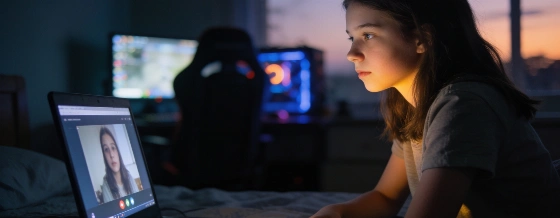
A teen describes feeling sidelined as her boyfriend spends more time gaming and less time connecting. A child psychologist explains why this pattern emerges and how to set boundaries that protect both closeness and independence
When your partner would rather spend hours gaming than talk to you, something changes. For 14-year-old Emily, it wasn’t just about missed calls or canceled plans—it was the slow realization that she was slipping down his list of priorities. Nightly video chats faded out, replaced by the blue glow of a computer screen and the endless pull of online games. When she finally asked if he’d lost interest, his answer was vague. The real hurt came from the growing distance between them.
This isn’t just about a boyfriend’s gaming habit. It’s about the fear of no longer mattering, of being pushed aside. Psytheater.com notes that this is common in digital-age relationships, especially for teens who connect mostly online. The waiting—hoping for a text, checking for a call—can feel like a test you never signed up for. Even when reassurance comes, it often feels thin, as if the real question (“Do I matter to you?”) is still unanswered.
A recent survey found that 45% of U.S. teenagers now believe they spend too much time on social media, up from 36% in 2022.
It’s easy to want more attention, to set ultimatums, or to ask for proof that you’re valued. But relationships built on constant checking and reassurance rarely feel secure. Psychologists suggest agreeing on clear expectations: decide together which evenings are for connecting, and which are for solo time. This isn’t about controlling your partner’s interests—it’s about making sure both people’s needs are seen. Without boundaries, resentment grows, and the relationship turns into a tug-of-war over time and attention.
There’s another side to this. For many teens, especially in online relationships, the partnership can become the center of their world. When that connection wobbles, it’s easy to feel lost. But giving up your own hobbies, friends, or interests for closeness rarely leads to real intimacy. It can actually make the loneliness worse. As one expert points out in a related piece on the emotional fallout of staying too close to an ex, the urge to cling often hides a deeper fear of being left behind.
Wanting more time together is valid. So is needing space for your own interests. The healthiest relationships aren’t about one person giving up everything—they’re about finding a rhythm where both closeness and independence have room. If your partner can’t or won’t meet you halfway, it’s not a sign to fight harder for scraps of attention. It’s a cue to invest in your own life, to build a foundation that doesn’t crumble when someone else pulls away. That’s how you keep your sense of self, no matter what happens next.
Research highlights that digital communication among teens—such as waiting for replies or feeling dependent on online contact—can intensify anxiety and uncertainty in relationships. Experts recommend setting clear, concrete boundaries with agreed-upon expectations, rather than relying on emotional pressure or ultimatums.
Online relationships can make both connection and insecurity feel bigger. Without shared routines or physical presence, it’s easy to misread signals or spiral into doubt. But the main challenge is the same: balancing the wish for closeness with the need for independence. Setting boundaries, talking openly, and keeping up your own interests aren’t just survival tactics—they’re what make a relationship last beyond the next game, call, or text.
Gaming disorder, now recognized by the World Health Organization, is more than just a phase for some teens. It can disrupt sleep, school, and relationships, especially when it becomes a main way to cope with stress or loneliness. Family therapy, cognitive behavioral strategies, and digital hygiene routines can help teens and parents find the line between healthy play and harmful escape. The goal isn’t to ban games, but to restore balance—so real-life connections don’t get lost in the digital noise.
A recent large-scale review found that early and heavy use of social media is linked to more symptoms of anxiety and depression among adolescents aged 10–15. The same research notes that digital spaces like gaming platforms often shift the focus away from personal connection and toward the activity itself, which can erode intimacy in teen relationships.
As reported in a 2026 health report, teens who spend more than three hours per day on social media are at about double the risk for symptoms of depression and anxiety compared to peers who spend less time online. This shows why setting healthy digital boundaries matters—not just for your own well-being, but for the quality of your relationships too.