Adults who revisit childhood games aren’t just chasing fun—they’re seeking something deeper
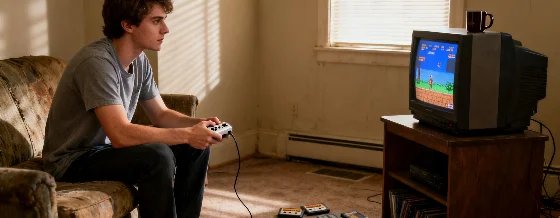
Booting up an old video game as an adult can feel like stepping into a time machine. The music, the menu, the controller—suddenly, you’re back in a room that doesn’t exist anymore. For many Americans over 25, the urge to replay childhood favorites isn’t just about entertainment. It’s a window into how memory, nostalgia, and identity collide.
According to Mariefrance, psychologists see this pattern as more than a simple longing for the past. When adults return to games like Pokémon or Zelda, they’re often searching for the emotional state they once had, not just the gameplay itself. The act of replaying is less about the pixels and more about reconnecting with a version of themselves that feels distant or even lost. As theorists have noted, nostalgia isn’t a faithful memory—it’s an emotional reconstruction, a longing for a home that may never have truly existed.
Memory and Identity
Our brains don’t store memories like files on a hard drive. Over time, details blur, and what remains is shaped by emotion and context. Psychologists describe a “reminiscence bump”—a tendency to remember adolescence and early adulthood more vividly than other periods. These years are when personal identity is forged, so the games, music, and stories from that era stick with us. When adults revisit old games, they’re not just recalling mechanics or graphics. They’re reliving afternoons without deadlines, summer breaks, friendships, and a sense of freedom that adulthood rarely allows. The mind smooths over the rough edges—long load times, clunky controls, repetitive levels—leaving behind an idealized version of the experience.
That’s why the emotional pull of childhood games can be so strong. The games become markers of who we were, not just what we played. The nostalgia is less about the software and more about the life that surrounded it.
Changing Immersion
As kids, many of us could lose ourselves in a game for hours, fully immersed and oblivious to the outside world. Psychologist Mihaly Csikszentmihalyi called this state “flow”—total absorption where time seems to vanish. For children and teens, this comes naturally. Every level feels new, and there’s no constant self-analysis or distraction.
But adulthood changes the equation. Experience brings pattern recognition and efficiency, but it also brings mental clutter. Adults spot game mechanics quickly, anticipate challenges, and rarely get lost in the moment. The ever-present mental load—work, errands, family obligations—makes it hard to fully escape. Even in the middle of a boss fight, part of your mind is thinking about tomorrow’s meeting or the groceries you forgot. The magic of total immersion is harder to recapture, replaced by a more analytical, sometimes distracted, engagement.
Emotional Time Travel
Neuroscience offers another layer. Researcher Endel Tulving distinguished between factual and emotional memory. When adults replay old games, it’s not just the facts—the levels, the music—that come back. It’s the emotional context: the room, the people, the feeling of a particular summer. In this way, retro gaming becomes a kind of mental time travel. The real draw isn’t the game itself, but the emotions tied to a specific chapter of life.
This helps explain why retro gaming remains so popular among adults. Old consoles aren’t just nostalgic toys—they’re emotional artifacts, reminders of a world that feels safer or simpler. The attachment isn’t about technical quality. It’s about the player’s own evolution. The games haven’t necessarily changed, but the person holding the controller has.
For some, this can be bittersweet. The realization that the past can’t be fully recaptured is part of growing up. But the act of revisiting these games can also be a healthy way to process change, loss, and the passage of time. It’s not about escaping reality, but about understanding how we carry our younger selves into adulthood.
In clinical psychology, nostalgia is increasingly recognized as a complex emotional state. It can offer comfort and continuity, but it can also highlight what’s missing in the present. Therapists sometimes use nostalgia as a tool to help clients explore identity, resilience, and the ways we adapt to change. For adults who find themselves drawn back to the games of their youth, the impulse is rarely trivial. It’s a sign of how memory, emotion, and self-understanding are woven together—and how the past continues to shape who we are now.