
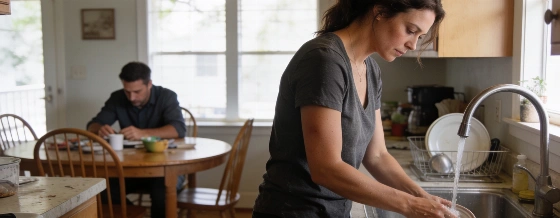
Many women find themselves managing home, kids, and work with little support from their spouse. This pattern can lead to exhaustion, resentment, and a sense of isolation
For many women, the phrase “I’m tired of being the strong one” isn’t just a passing complaint—it’s a chronic reality. Balancing a career, raising children, and running a household often falls on one partner’s shoulders, while the other remains passive or only helps when asked. According to Psytheater.com, this dynamic can quietly erode trust and intimacy, leaving the more active partner feeling depleted and alone.
It’s easy to believe that letting go of control or showing vulnerability will somehow threaten the stability of your family. In truth, the opposite is often the case. When one person carries the entire mental and emotional load, the resulting tension and burnout can do more damage to a relationship than any single act of “weakness.”
Understanding why you feel compelled to be the “strong one” is a critical first step. For some, it’s a habit learned in childhood or a fear that asking for help will lead to rejection. Others may have internalized the idea that their worth is tied to how much they can handle alone. These beliefs are powerful, but they can be challenged.
Breaking the Cycle
Learning to ask for help is not a sign of weakness. It’s a marker of emotional maturity and a way to build trust within a partnership. When you request support, you’re not abandoning responsibility—you’re inviting your partner to share in it. This can be as simple as dividing chores: “I’ll handle the dishes, can you sweep the kitchen?” The key is to delegate without micromanaging. Once you’ve agreed on a division of labor, resist the urge to oversee every detail. Adults need space to do things their own way, even if it’s not exactly how you would do it.
Communication is essential. Instead of letting resentment build, talk about your feelings directly. Swap accusations for honest statements: “I feel exhausted and alone. I need to know we’re in this together.” This approach opens the door to real change, rather than fueling a cycle of blame and defensiveness.
Letting Go of Perfection
It’s important to recognize that being a strong woman doesn’t mean carrying everything alone. True strength is about resilience, adaptability, and the ability to connect with others—not about relentless self-sacrifice. Allowing yourself to be cared for, even in small ways, can be deeply uncomfortable if you’re used to earning every bit of support. But accepting help is not a failure; it’s a necessary part of healthy relationships.
Many women struggle with the idea that if they stop doing everything, the family will fall apart. In reality, families are more likely to fracture under the weight of chronic stress and unspoken resentment. As one recent feature on the anxiety mothers face after maternity leave shows, the inability to step back and share responsibility can lead to lasting emotional fallout.
Building New Patterns
Start by identifying the moments when you feel most overwhelmed. What tasks or situations trigger the sense that you’re alone in this? Practice letting go, even if it’s just for an hour or a day. Notice how your partner responds when given the chance to step up. Change won’t happen overnight, but small shifts can build momentum.
Consider professional support if the pattern feels stuck. Couples therapy, individual counseling, or even structured family meetings can help reset expectations and open new lines of communication. Remember, the goal isn’t to become “weak,” but to create a partnership where both people can be strong—and vulnerable—together.
Recent research from the Pew Research Center found that 59% of American mothers report feeling solely responsible for managing their family’s schedules and daily needs, even when both partners work full-time. This “mental load” is a leading cause of burnout and relationship dissatisfaction, highlighting the urgent need for more equitable sharing of household and emotional labor.
Books like “K sebe nezno. Kniga o tom, kak tsenit i berech sebya” by Olga Primachenko, “Buy Yourself the F*cking Lilies” by Tara Schuster, and “Metod ‘Genesis’: polyubi sebya bolshe sem’i i raboty” by Irina Maslova offer practical strategies for women seeking to reclaim balance and self-compassion. These resources emphasize that self-worth is not measured by how much you endure, but by your ability to care for yourself as well as others.