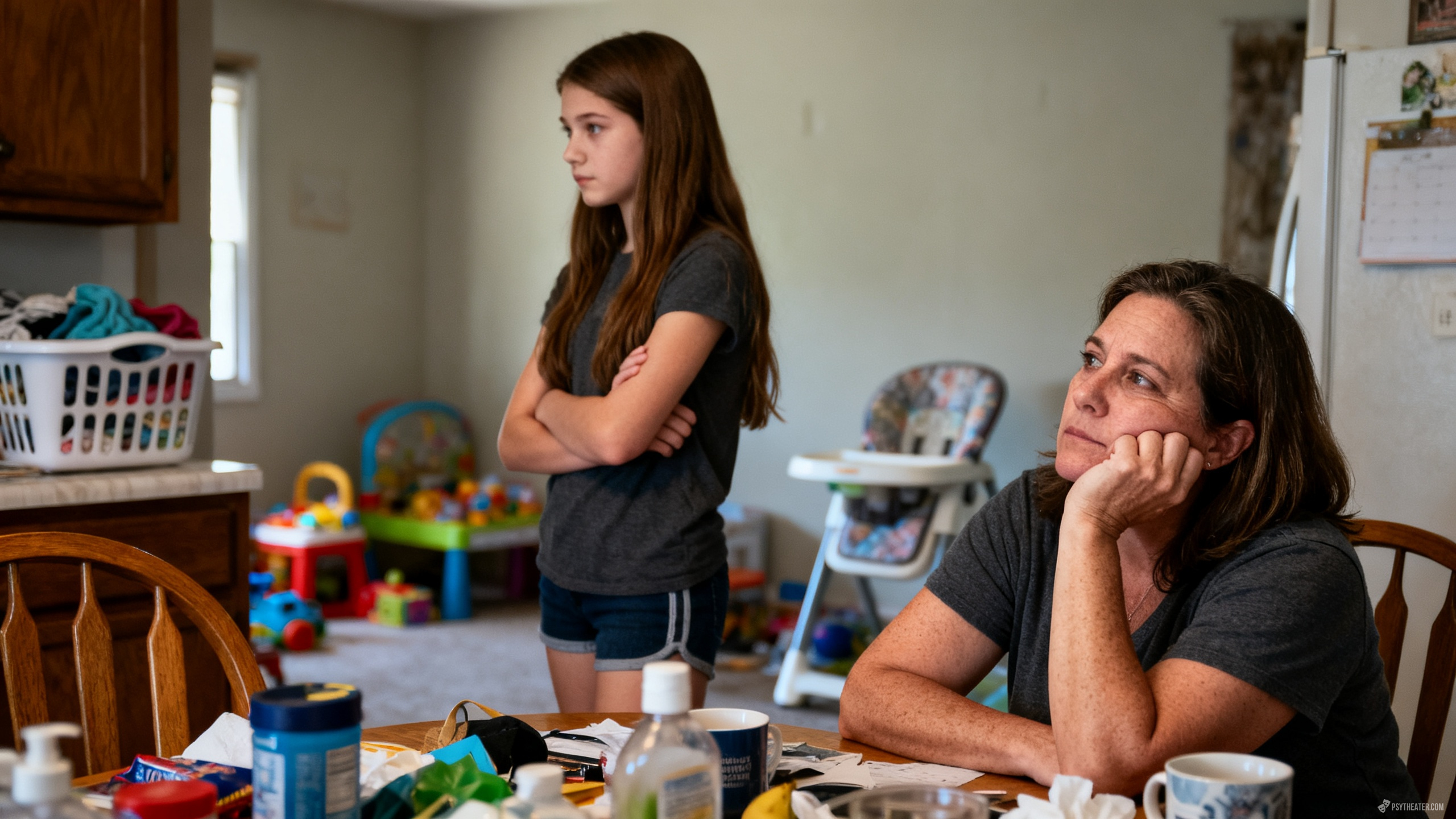
At 39, Jessica is raising three kids in a small Midwestern town. Her oldest, a 14-year-old daughter, has become the center of daily conflict. Jessica describes a home where every request from her teen is met, from new school clothes to a phone upgrade, yet nothing seems to satisfy. The daughter’s gratitude is fleeting, her complaints constant. She points out every parental shortcoming, keeps her room in chaos, and often bullies her younger sister. Jessica, home on maternity leave with a baby, feels invisible and spent. The family lives on her husband’s single income, but her daughter’s demands don’t slow down. When asked to help, the teen either refuses or insists she’s not responsible for her siblings. Jessica admits she sometimes wishes her daughter would just leave, a thought that brings guilt but also relief.
According to Psytheater.com, this dynamic is not rare. Many parents of teens feel overwhelmed, especially when the oldest child tests every limit. The expert perspective is blunt: Jessica is experiencing parental burnout, while her daughter is deep in the classic adolescent crisis. At 14, teens often push boundaries, seeking to assert control and test the strength of family rules. The daughter’s behavior—what Jessica calls “parasitic”—is less about character and more about fear. With attention now split among three kids, the oldest feels left behind, unsure how to get noticed except through conflict. Acting out becomes a way to check if her mother’s love is still there, even when she’s at her worst.
One core issue is a breakdown in family hierarchy. The teen has, in effect, taken charge, dictating terms and pulling siblings into disputes. Modern parenting often emphasizes acceptance and self-expression, but the expert notes that clear parental authority is just as vital. Teens need to know that adults set the rules and enforce boundaries. When parents give in to every demand, kids lose their sense of security and respect. This can fuel anxiety, which often shows up as anger or defiance. Jessica’s attempts to appease her daughter—buying things, avoiding conflict—have only deepened the problem. The daughter has learned that emotional outbursts can get her what she wants, and that rules are negotiable.
Restoring Balance
To shift the dynamic, the expert recommends reestablishing clear rules and consequences. Instead of arguing or pleading, Jessica should calmly state expectations: adults make decisions, anger is allowed but insults are not, and responsibilities are non-negotiable. If the teen refuses to clean her room, she loses privileges like going out with friends. If she wants something expensive, she can save up for it, just as the family does for other needs. The key is consistency—no more bending the rules to avoid a scene. Over time, this approach can help the teen feel safer, even if she protests loudly at first.
Another strategy is to separate acts of care from expressions of love. Cooking, cleaning, and laundry are necessary, but teens often take them for granted. What they crave is focused attention. The expert suggests carving out 15–20 minutes each day for one-on-one time with each child, just to talk or share a snack—no lectures, no chores. Once a month, Jessica should try to spend a few hours alone with each child, reinforcing their unique bond. This is especially important in larger families, where kids can feel lost in the shuffle.
Self-Care and Support
Jessica’s exhaustion is real and valid. The myth of the endlessly self-sacrificing mother is damaging, especially when resources are tight and support is thin. The expert urges her to claim at least half an hour a day for herself, even if it means letting some chores slide. She also points out the need for the father to be more involved—not just as a provider, but as an active parent who gives Jessica breaks and connects with the kids. Without this, burnout will only deepen, and family tensions will rise.
Finally, the expert reminds Jessica that adolescence is a phase, not a permanent state. The harsh words and rebellious acts are not personal attacks, but clumsy attempts to navigate growing up. The only way through is to hold firm boundaries, offer steady love, and take care of her own well-being. The process is slow, but change is possible.
For parents struggling with similar issues, several books offer practical guidance: Nikita Karpov’s “Чертовы подростки! Как найти общий язык с повзрослевшим ребенком,” Ekaterina Burmistrova’s “Подростки. Как пережить пубертат,” and Natalia Zelenina’s “Подростки на перекрестке. Руководство по воспитанию.”
Adolescent defiance is often mistaken for a personality flaw, but in clinical psychology, it’s recognized as a normal—if difficult—part of development. Teens test boundaries to find out where they stand and to build a sense of self. When parents respond with clear limits and emotional steadiness, teens are more likely to develop resilience and respect. Family therapy can help when patterns become entrenched, offering tools for communication and conflict resolution. The goal is not to eliminate conflict, but to make it productive and less destructive for everyone involved.